How to Layer Perfume: The Right Order, Ratio and Placement
How to layer perfume in 6 simple steps: which scent goes first, how many sprays of each and where to put them so the blend doesn't turn muddy.
In this guide
To layer perfume, spray the heavier, longer-lasting scent first and the lighter one on top, starting with 2 sprays of the base and 1 of the top. If both perfumes are heavy, spray them on different spots so neither one drowns the other.
That’s the whole method in two sentences. Below is how to tell which of your perfumes is “heavy”, the 6 steps to layer any two bottles you already own, and the mistakes that turn a nice blend muddy.
What perfume layering is
Perfume layering means wearing two scents at the same time to create a third one that’s yours. You can layer two perfumes, a perfume and a body mist, or a scented lotion and a perfume.
You don’t need special “layering” perfumes. Any two bottles can work if you know their main notes and put them on in the right order.
Light, medium and heavy notes
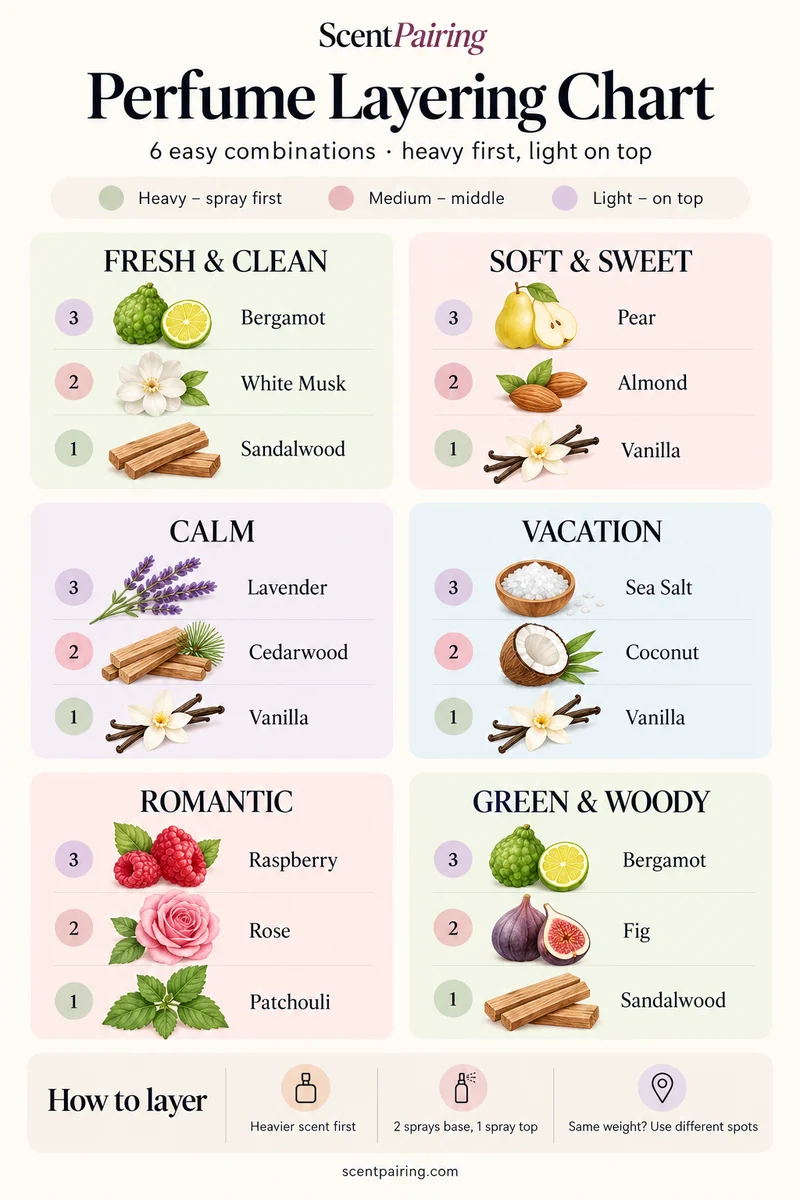
Every note has a weight. Light notes are bright and evaporate fast; heavy notes are rich and last for hours. This is the practical classification our layering finder uses. It’s a guide, not an official standard, but it predicts the right order for most pairs.
| Weight | Notes | What it means for layering |
|---|---|---|
| Light | Bergamot, orange blossom, pear, raspberry, sea salt, lavender | Fade first. They go on top. |
| Medium | Fig, cherry, rose, jasmine, tuberose, iris, coconut, almond, pistachio, white musk, cedarwood, vetiver | The heart of most blends. On top of heavy notes, under light ones. |
| Heavy | Vanilla, caramel, coffee, sandalwood, patchouli, amber, oud, tobacco, leather | Last for hours. They go on first. |

Want it on paper? Our free perfume layering chart puts 6 easy combinations in the right order, ready to print.
How to layer perfume in 6 steps
1. Find the main note of each perfume
Look up each perfume on the brand’s website or check the box. Most list top, heart and base notes. Pick the note you actually smell most after an hour: that’s usually the one that defines the perfume.
If a perfume lists bergamot, neroli and white musk, its main character is fresh and musky. If it lists sandalwood, cedarwood and vanilla, it’s creamy and woody.
2. Check that the families get along
Some note families blend easily: woods with almost everything, florals with amber or musk, fruit with gourmand notes. Others fight, like sharp aquatic notes with smoky ones. Our scent families show which ones get along, and the pair checker gives you a verdict for any two notes.
3. Spray the heavier scent first
The heavy perfume is your base. Spray it first so the lighter one sits on top, where you notice it right away. If you do it the other way around, the heavy scent covers the light one and you lose the fresh part of the blend.
4. Start with 2 sprays of the base and 1 of the top
A 2 to 1 ratio is a safe starting point. If the top note disappears after an hour, add a second spray next time. If the base takes over, drop it to one spray.
5. Same spot or different spots
Spray both on the same spot when you want them to blend into one scent. Spray them on different spots (for example, one on the wrists and one on the neck) when both are heavy, or when one is very strong. That way you smell both instead of a muddle.
6. Wait 20 minutes before you judge it
The first minute is mostly top notes and alcohol. Give it about 20 minutes, then smell again. That’s the real blend you’ll wear all day.
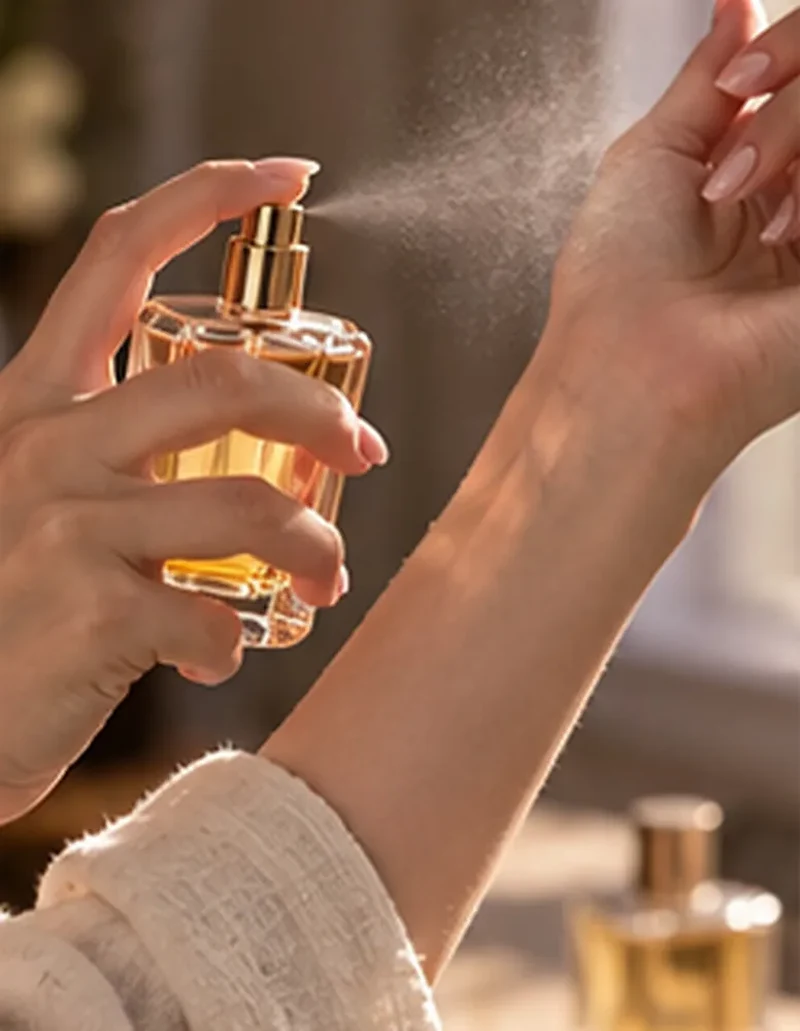
3 easy pairs to start with
Want a guided start? Follow our 7-day perfume layering plan for beginners, one pair a day. Already comfortable with two? Try layering three perfumes.
Vanilla + Bergamot
Heavy under light, the textbook layering pair. Bright citrus over soft vanilla, like a lemon cream tart.
Layering order: Vanilla first (2 sprays), bergamot on top (1 spray).
Check this pair in the finderSandalwood + White musk
Heavy under medium. Creamy wood and clean skin, a quiet scent you can wear anywhere.
Layering order: Sandalwood first (2 sprays), musk on top (1 spray).
Check this pair in the finderRose + Amber
Amber turns rose into a warm, honeyed evening scent. A good way to wear florals when it gets cold.
Layering order: Amber first (2 sprays), rose on top (1 spray).
Check this pair in the finderLayering with lotion and body mist
The same rule works for body products. A scented lotion or body wash is your first, lightest layer; perfume goes on top. Body mists are lighter than perfume, so spray them last, over the perfume, or use them to refresh at lunch.
If you want your perfume to stay in charge, use an unscented lotion. If you want to stretch a scent, match the lotion to the perfume’s main note, like a vanilla lotion under a vanilla perfume. For easy everyday pairs, see our clean perfume layering combos, and for a full shower-to-evening routine, our 20 ways to smell good all day.
Keep a simple layering journal
When you find a pair you like, write it down so you can repeat it:
| What to note | Example |
|---|---|
| Perfumes | Your vanilla perfume + your bergamot perfume |
| Main notes | Vanilla, sandalwood / bergamot, neroli |
| Order and sprays | Vanilla first (2), bergamot on top (1) |
| After 20 minutes | Creamy, fresher than vanilla alone |
| Later in the day | Bergamot faded, vanilla still there |
| Next time | Add a second spray of bergamot |
5 layering mistakes to avoid
The five most common ones are below; the full list with fixes is in 9 perfume layering mistakes that make you smell muddy.
- Two dense, sweet scents together. Vanilla plus caramel plus a sugary body mist turns cloying fast. Pair one sweet note with something fresh or dry.
- Too many sprays. Two layered perfumes are stronger than one. Use fewer sprays of each than you would alone.
- Judging in the first minute. Wait about 20 minutes.
- Rubbing your wrists. It blurs the top notes. Spray and let it dry.
- Three scents with no base. If you add a third scent, make sure one of the three is heavy enough to hold the others together.
Ready for ideas? Browse 25 perfume layering combinations sorted by mood, 15 vanilla perfume combinations or our fall perfume layering combinations. Prefer flowers or fruit? Try floral perfume layering or fruity perfume layering.
Questions about layering perfume
Which perfume goes first when layering?
The heavier, longer-lasting one: woods, vanilla, amber, smoky notes. Lighter scents like citrus, fruit and light florals go on top. If both are heavy, spray them on different spots.
Can you layer any two perfumes?
Most pairs can work if you get the order and amounts right, but some families fight, like sharp aquatic notes with smoky ones. Check the two main notes in our pair checker before you try.
How many sprays should I use when layering?
Start with 2 sprays of the base and 1 of the top. With very strong notes such as oud, tobacco or tuberose, use just 1 spray of that perfume.
Does layering make perfume last longer?
It can help. A heavy base note usually lasts longer than a light perfume worn alone, so layering a light scent over a heavier one often keeps it noticeable for longer. Results depend on the perfumes and your skin.
Can you layer perfumes from different brands?
Yes. Brands don’t matter; the notes do. Match the perfumes by their main notes, not by the name on the bottle.